
Nationwide federal criminal defense
Serious Federal Charges.
Strategic Defense.
Nationwide Representation.
Defending Federal Cases Nationwide.
Federal criminal defense
What Are You Facing?
- Federal Drug ChargesFederal drug trafficking, conspiracy, distribution and related federal narcotics offenses.21 U.S.C. §§ 841, 846, 852 and others.
- Federal Sex CrimesDefense for serious federal sex offenses and investigations.18 U.S.C. chs. 109A, 110, 117 and others.
- Federal Firearms ChargesFederal firearm possession, use, trafficking and related weapons charges.18 U.S.C. §§ 922(g), 924(c) and others.
- Federal Fraud ChargesWire fraud and other serious federal fraud investigations and prosecutions.18 U.S.C. §§ 1341, 1343, 1344, 1347 and others.
- Human TraffickingDefense for federal human trafficking and related conspiracy allegations.18 U.S.C. §§ 1589, 1591 and others.
- Money LaunderingDefense for federal money laundering investigations and charges.18 U.S.C. §§ 1956, 1957 and others.
- Federal KidnappingDefense against serious interstate and federal kidnapping allegations.18 U.S.C. § 1201 and others.
- Witness TamperingDefense involving allegations of intimidation, influence, obstruction or witness tampering.18 U.S.C. § 1512 and others.
- Federal AppealsDefense for federal criminal appeals and post-conviction matters.28 U.S.C. § 1291, 18 U.S.C. § 3742 and others.
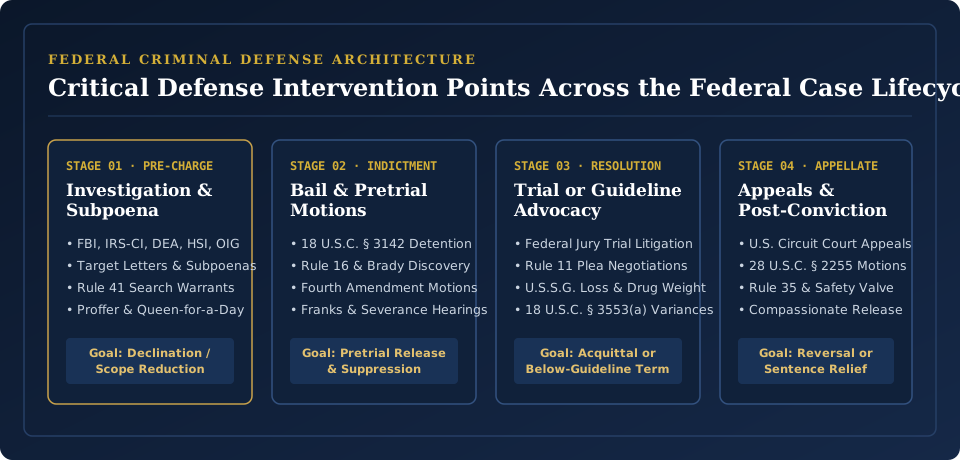
The federal case lifecycle
Where Are You in the Federal Criminal Process?
- Federal Investigation
FBI, IRS-CI, DEA, HSI and ATF investigations can begin long before an arrest.
- Target Letter or Subpoena
A target letter or federal subpoena can signal that prosecutors or a grand jury are actively examining potential criminal conduct.
- Grand Jury
Federal prosecutors may use the grand jury to obtain evidence and seek an indictment.
- Search Warrant or Raid
A federal search can be a critical turning point in an investigation.
- Arrest or Indictment
Once formal charges are filed, detention, discovery, motions, plea negotiations and trial strategy become immediate concerns.
- Federal Sentencing
Federal sentencing can involve advisory guidelines, statutory penalties, enhancements, mitigation and advocacy for a lower sentence.
- Appeal or Post-Conviction
Federal appeals, § 2255 motions and compassionate release involve distinct standards and procedures.
Federal law enforcement
Which Federal Agency Is Investigating You?
High-intent federal events
Federal Agents Contacted You? What Happens Next Matters.
California + nationwide
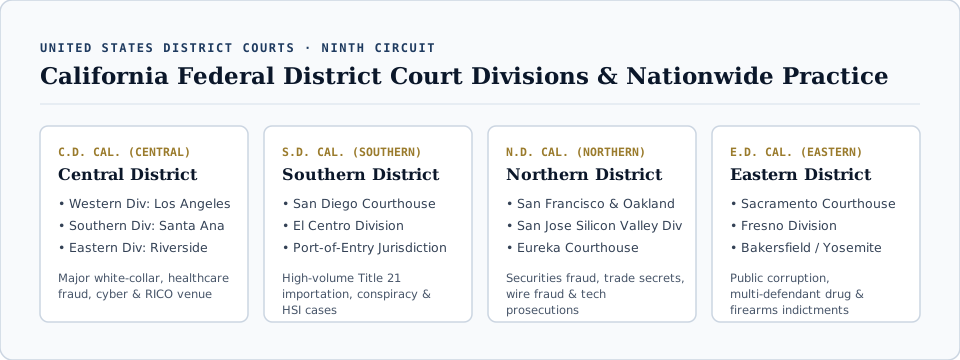
National Federal Defense. Deep California Experience.
- Central District of CaliforniaLos Angeles, Santa Ana and Riverside federal court coverage.
- Southern District of CaliforniaSan Diego and El Centro federal court coverage.
- Northern District of CaliforniaSan Francisco, Oakland and San Jose federal court coverage.
- Eastern District of CaliforniaSacramento and Fresno federal court coverage.
Federal Criminal Defense Overview
Why Federal Criminal Defense Demands Specialized Trial and Pre-Indictment Strategy
Defending a criminal matter in a United States District Court is fundamentally different from defending a charge in state court. Federal prosecutions are brought by Assistant United States Attorneys (AUSAs) and specialized Department of Justice trial attorneys backed by multi-agency investigative task forces. Before a federal prosecutor ever asks a grand jury to return a formal federal indictment, federal agents have often spent months—or years—issuing administrative and grand jury subpoenas, analyzing financial and digital records, executing search warrants, and interviewing witnesses. According to annual statistical reports published by the United States Sentencing Commission (USSC) and the Administrative Office of the U.S. Courts, more than 90 percent of charged federal defendants resolve their cases through guilty pleas, underscoring how decisive early legal intervention, rigorous pretrial motion practice, and sentencing guideline litigation are to protecting a client's liberty and career.
Unlike state prosecutions that frequently begin with a street arrest followed by a rapid charging decision, the federal criminal process is governed by Title 18 of the United States Code, the Federal Rules of Criminal Procedure, the Federal Rules of Evidence, and the advisory United States Sentencing Guidelines. Every procedural milestone—from responding to a pre-charge inquiry to litigating pretrial release at a federal detention hearing under the Bail Reform Act (18 U.S.C. § 3142)—carries permanent consequences. Engaging experienced federal defense counsel at the earliest sign of government scrutiny allows the defense to evaluate the government's theory, protect constitutional privileges, and pursue charge declination or narrowing before an indictment is unsealed.
Pre-Indictment Federal Investigations, Target Letters, and Grand Jury Subpoenas
The most leveraged window in any federal matter is the pre-indictment federal investigation stage. Individuals and corporate executives typically learn of a federal inquiry in one of four ways: receiving an official DOJ target letter informing them that they are the target or subject of a grand jury probe; being served with a federal grand jury subpoena for testimony (subpoena ad testificandum) or records (subpoena duces tecum); experiencing an early-morning federal search warrant or federal raid at a residence, medical practice, or business office; or being approached by special agents seeking a voluntary “knock-and-talk” interview.
Speaking directly to federal agents without counsel present is one of the most dangerous mistakes a person under scrutiny can make. Under 18 U.S.C. § 1001, making any materially false, fictitious, or fraudulent statement to a federal agent is an independent felony punishable by up to five years in federal prison—even if the conversation takes place on a front porch, is not under oath, and no underlying crime is ultimately proven. Whether the inquiry is led by FBI special agents, IRS Criminal Investigation (IRS-CI), the Drug Enforcement Administration (DEA), Homeland Security Investigations (HSI), or the Bureau of Alcohol, Tobacco, Firearms and Explosives (ATF), counsel immediately steps between the client and the government. Defense counsel assumes all communications with the AUSA, evaluates Fifth Amendment act-of-production privileges in subpoena responses, audits Rule 41 warrant affidavits for Franks v. Delaware suppression challenges, and determines whether a structured proffer session or written declination presentation is in the client's strategic interest.
Major Federal Criminal Charges Under Titles 18, 21, and 26 of the U.S. Code
Federal criminal jurisdiction encompasses a wide range of statutory federal offenses involving interstate commerce, federal agencies, financial institutions, healthcare programs, and international borders. In federal white-collar and financial crime prosecutions, prosecutors routinely stack substantive counts of wire fraud, mail fraud, bank fraud, and health care fraud with federal conspiracy (18 U.S.C. §§ 371 and 1349), federal embezzlement and theft, and promotional or concealment money laundering under 18 U.S.C. §§ 1956 and 1957. In these cases, sentencing exposure is heavily driven by the intended or actual pecuniary loss calculation under U.S.S.G. § 2B1.1 and alleged sophisticated-means or leadership enhancements.
In narcotics, weapons, and violent offense prosecutions, statutory mandatory minimums frequently control the floor of any potential sentence. Federal drug trafficking and conspiracy charges under 21 U.S.C. §§ 841 and 846 carry 5-year and 10-year mandatory minimum prison terms tied to specific drug quantity thresholds, while federal firearms offenses under 18 U.S.C. § 922(g) and § 924(c) impose severe, often consecutive prison sentences when a firearm is alleged to have been possessed in furtherance of a drug trafficking crime or crime of violence. Similarly, prosecutions involving federal sex offenses, human trafficking under Chapter 77, federal kidnapping (18 U.S.C. § 1201), and witness tampering or obstruction of justice (18 U.S.C. § 1512) require immediate forensic, constitutional, and evidentiary scrutiny.
| Federal Offense Category | Primary U.S. Code Statutes | Key Guidelines & Statutory Exposure |
|---|---|---|
| Wire, Mail, Bank & Health Care Fraud | 18 U.S.C. §§ 1341, 1343, 1344, 1347, 1349 | Up to 20–30 years statutory maximum; driven by U.S.S.G. § 2B1.1 loss table |
| Controlled Substances Trafficking & Conspiracy | 21 U.S.C. §§ 841(a)(1), 846, 952, 960 | 5-year or 10-year mandatory minimums to life; U.S.S.G. § 2D1.1 drug quantity table |
| Federal Firearms & § 924(c) Offenses | 18 U.S.C. §§ 922(g), 924(a)(8), 924(c) | Up to 15 years on § 922(g); 5, 7, or 10-year consecutive mandatory minimums under § 924(c) |
| Money Laundering & Monetary Transactions | 18 U.S.C. §§ 1956, 1957; 31 U.S.C. § 5324 | Up to 10–20 years statutory maximum; U.S.S.G. § 2S1.1 enhancements and asset forfeiture |
| Federal Sex Crimes & Child Exploitation | 18 U.S.C. §§ 2241–2244, 2251, 2252A, 2422 | 5, 10, or 15-year mandatory minimums up to life; SORNA registration and lifetime supervised release exposure |
Federal Sentencing Guidelines, Mandatory Minimums, and Post-Conviction Relief
Even when the government's evidence is contested, preparing effectively for federal sentencing begins on day one of the representation. Under the framework established by United States v. Booker, federal judges must first accurately calculate the advisory guideline range using Base Offense Levels, Specific Offense Characteristics, role adjustments, acceptance-of-responsibility reductions, and Criminal History Categories, and then weigh the statutory sentencing factors under 18 U.S.C. § 3553(a). Our defense team challenges unproven guideline enhancements during the Presentence Investigation Report (PSR) process and prepares comprehensive mitigation submissions seeking downward departures and non-guideline variances. Readers can also explore how offense levels and criminal history categories interact using our interactive Federal Sentencing Guidelines Calculator.
Where statutory minimums apply, our attorneys evaluate every avenue to overcome a federal mandatory minimum sentence, including statutory Safety Valve relief under 18 U.S.C. § 3553(f), substantial-assistance motions, and post-sentencing Rule 35(b) sentence reductions or retroactive guideline amendment reductions under 18 U.S.C. § 3582(c)(2). Following a conviction or sentencing, we represent clients in direct federal criminal appeals before the United States Courts of Appeals, collateral constitutional challenges via 28 U.S.C. § 2255 habeas corpus motions, and federal compassionate release petitions.
California U.S. District Courts and Nationwide Federal Court Representation
Federal Criminal Law Center defends clients across all United States District Courts nationwide—including federal venues in New York, Texas, Florida, Arizona, Nevada, and Washington—with deep roots across all four California federal judicial districts. Whether a case is pending in the Central District (Los Angeles, Santa Ana, Riverside), the Southern District (San Diego, El Centro), the Northern District (San Francisco, Oakland, San Jose), or the Eastern District (Sacramento, Fresno), local district practice and Ninth Circuit precedent shape every bail argument, suppression motion, and sentencing hearing.
More From Federal Criminal Law Center
Talk With a Federal Criminal Defense Attorney
If you are under federal investigation, have been contacted by federal agents, received a target letter or subpoena, or are facing an indictment or sentencing, seek legal advice before making decisions that may affect the case.